Written and medically reviewed by Sean E. Mazloom, MD, FAAD, Double Board-Certified Dermatologist and Mohs Surgeon
REJUVA Dermatology, Vein & Cosmetic Center | Venice, Florida
Table of Contents
The Short Answer: Which Skin Cancer Treatment Is Best?
If you have just been diagnosed with basal cell carcinoma (BCC) or squamous cell carcinoma (SCC), the most important question is not simply “Which treatment is easiest?” It is: “Which option gives me the best balance of cure, tissue preservation, recovery, number of visits, and cosmetic outcome for this particular cancer?”
For many skin cancers, surgery, especially Mohs surgery for higher-risk tumors and cosmetically sensitive areas, offers the most established cure rates. Standard excision is highly effective for many lower-risk tumors. For appropriately selected patients who cannot or prefer not to have surgery, nonsurgical radiation options such as electronic brachytherapy (EBT) or superficial radiation therapy (SRT) may be considered.
At REJUVA in Venice, Florida, we evaluate both surgical and nonsurgical options. That matters because the right answer depends on the tumor and the patient, not simply on which technology a practice happens to offer.
This guide covers basal cell and squamous cell carcinoma. Melanoma is evaluated and treated differently, and radiation options such as EBT and SRT are not standard treatment for it.
I Was Just Diagnosed With BCC or SCC. How Do I Choose Between Mohs, Excision, EBT, and SRT?
Start with five questions:
- Where is the cancer located: nose, eyelid, lip, ear, scalp, hand, trunk, arm, or leg?
- Is it low risk or high risk based on size, subtype, borders, recurrence, and other pathology features?
- How important is immediate margin confirmation and maximum preservation of healthy tissue?
- Am I medically comfortable with surgery and wound care?
- How much do treatment frequency, travel, downtime, and avoiding an incision matter to me?
Mohs vs. Excision vs. EBT vs. SRT at a Glance
| Question | Mohs | Excision | EBT | SRT / image-guided SRT (IGSRT) |
| Typical role | First-line for many high-risk tumors and sensitive sites | First-line for many lower-risk tumors | Nonsurgical option for selected patients | Nonsurgical option for selected patients |
| Margin check | Same day; mapped microscopic margin examination | Pathology after removal | No surgical margin examination | No surgical margin examination |
| Visits | Usually one treatment visit, plus follow-up as needed | Procedure plus follow-up/suture removal | At REJUVA, typically about 10–12 treatments | Often more visits over several weeks, depending on protocol |
| Incision/stitches | Yes, with repair as needed | Yes | No | No |
| Often considered when | Highest cure/tissue preservation are priorities | Low-risk tumor is suitable for standard removal | Patient wants or needs a nonsurgical option with a shorter course | Patient wants or needs nonsurgical radiation |
No single table can determine your treatment. Tumor location, pathology, prior treatment, overall health, and your goals can change the recommendation.
Not sure which option fits your diagnosis? Schedule a skin cancer consultation at REJUVA in Venice: (941) 529-0070.
When Is Mohs Surgery Usually the Better Choice?
Mohs is particularly valuable when a skin cancer is on the nose, eyelid, lip, ear, scalp, hand, or another area where preserving healthy tissue matters; when the tumor is recurrent or poorly defined; or when other features make it higher risk. Mohs removes the cancer layer by layer and examines the mapped margins during the same visit, allowing additional tissue to be removed only where cancer remains.
Does Mohs Usually Require General Anesthesia?
No. Mohs is typically performed in the office using local anesthesia. Patients remain awake and usually go home the same day.
When Is Standard Excision a Good Option?
Standard excision can be an excellent treatment for many lower-risk BCCs and SCCs, especially on the trunk, arms, and legs. The tumor and an appropriate margin are removed, and the specimen is sent to pathology. Unlike Mohs, complete mapped margin assessment is not performed while you wait.
When Might EBT Be a Reasonable Alternative to Surgery?
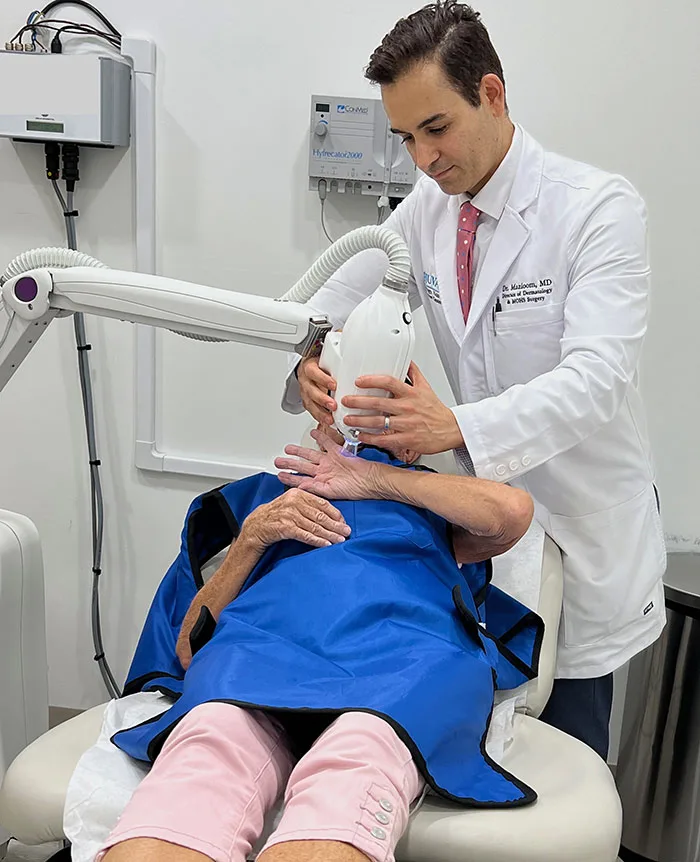
Electronic brachytherapy delivers focused low-energy radiation directly at the skin surface without an incision or stitches. It may be considered for appropriately selected patients who are not ideal surgical candidates or who prefer a nonsurgical approach after discussing the tradeoffs.
At REJUVA, our EBT protocol typically involves about 10–12 treatment sessions.
Is EBT the Same as SRT or GentleCure?
No. GentleCure is a brand of image-guided SRT. EBT and SRT are related skin-directed radiation approaches, but the radiation is delivered differently and treatment schedules can differ. Conventional SRT or image-guided SRT protocols may involve more visits over several weeks. EBT places the radiation source directly over the treatment area. The appropriate modality depends on the tumor, medical history, prior radiation, and treatment goals.
Which Option Is Best if I Care Most About Appearance?
Cosmetic outcome cannot be predicted from the treatment name alone. With Mohs, the goal is to remove the cancer while preserving as much normal tissue as possible, which can be especially important on the face. Surgery does create a wound and may leave a scar. Radiation avoids an incision, but treated skin can develop redness during therapy and later pigment, texture, thinning, or visible-vessel changes. The best cosmetic strategy starts with choosing an oncologically appropriate treatment and then considering the likely repair or skin response at that specific location. When a repair is needed after Mohs, REJUVA’s fellowship-trained facial plastic surgeon, Dr. Steve Kang, performs Mohs reconstruction.
Which Treatment Has the Fewest Visits?
Mohs is usually completed in a single treatment visit, although follow-up and suture removal may be needed. Excision is also generally a single procedure with follow-up. Radiation requires a series of visits. At REJUVA, EBT generally involves approximately 10–12 sessions, while SRT schedules may require substantially more visits depending on the protocol.
Does Age Determine Whether I Should Choose Surgery or Radiation?
No. A healthy patient in their 80s may be a good Mohs candidate, while a younger patient with significant medical or healing concerns may have different considerations. The tumor’s risk, your overall health, mobility, medications, ability to perform wound care, and personal priorities matter more than age alone.
How We Help Patients Choose at REJUVA
A useful consultation should answer a very specific question: “For my exact skin cancer, what would you recommend if cure, appearance, convenience, and recovery all matter to me?” We review the pathology, examine the site and size, assess risk features, discuss your health and preferences, and explain the reasonable options, including why one option may be favored over another.
If you have recently been diagnosed with BCC or SCC and are deciding between Mohs surgery, excision, EBT, or another nonsurgical treatment, call (941) 529-0070 to schedule a skin cancer consultation at REJUVA Dermatology, Vein & Cosmetic Center, 395 Commercial Ct, Suite C, Venice, FL 34292. We also care for patients from Sarasota, Wellen Park, North Port, Englewood, and surrounding Southwest Florida communities.
Frequently Asked Questions Patients Ask Before Choosing Treatment
Is Mohs Better Than Radiation for Basal Cell or Squamous Cell Carcinoma?
For many higher-risk BCCs and SCCs, Mohs has the most established cure rates and allows same-day microscopic margin assessment. Radiation can be an important alternative for selected patients who cannot or prefer not to have surgery.
Is EBT as Effective as Mohs?
Mohs has the longer and more established evidence base. EBT studies report encouraging local-control results in selected nonmelanoma skin cancers, but long-term evidence is less extensive than for surgery.
Can I Choose EBT Just Because I Do Not Want a Scar?
Avoiding an incision is a legitimate preference, but treatment choice should first account for the cancer’s risk and location. Radiation can also produce short- and long-term skin changes, so the cosmetic tradeoff should be discussed rather than assuming “no incision” means “no visible change.”
What if My Dermatologist Recommended Mohs but I Want a Nonsurgical Option?
A second discussion is reasonable. Ask why the tumor was considered appropriate for Mohs, whether radiation is medically reasonable for that exact tumor, what the expected number of visits is, and what is known about recurrence and long-term skin changes.
Where Can I Get Both Mohs and EBT Evaluated Near Venice or Sarasota, Florida?
REJUVA Dermatology, Vein & Cosmetic Center in Venice offers Mohs surgery and EBT, allowing eligible patients to discuss surgical and nonsurgical options in the same practice. Patients from Sarasota, Wellen Park, North Port, and Englewood are seen at the Venice office.
References
National Comprehensive Cancer Network. Squamous Cell Skin Cancer. 2026-03-17.
National Comprehensive Cancer Network. Basal Cell Skin Cancer. 2026-08-21.
Kizy SM, Baylis LT, Nellis J, et al. Non-Surgical Therapies for Localized Non-Melanoma Skin Cancer in Older Adults: A Review. J Geriatr Oncol. 2026;18(1):104122.
Wehner MR. Keratinocyte Carcinoma: A Review. JAMA. 2026;335(1):70-81.
American Academy of Dermatology. Position Statement: Superficial Radiation Therapy for BCC and SCC. 2021.
National Comprehensive Cancer Network. Older Adult Oncology. 2026-09-04.
Perez KD, Hong D, Zhong X, et al. Adapting the Geriatric Medicine 5Ms Framework to Geriatric Dermatology. Drugs Aging. 2026;43(7):543-557.
Sreekantaswamy S, Endo J, Chen A, et al. Aging and the Treatment of Basal Cell Carcinoma. Clin Dermatol. 2019;37(4):373-378.
Kim JYS, Kozlow JH, Mittal B, et al. Guidelines of Care for the Management of Cutaneous Squamous Cell Carcinoma. J Am Acad Dermatol. 2018;78(3):560-578.
Junn A, Shukla NR, Morrison L, et al. Development of a patient decision aid for superficial BCC in adults with a limited life expectancy. BMC Med Inform Decis Mak. 2020;20(1):81.
Kizy SM, Hannawa O, Messiha S, et al. Dermatologic Surgery in Elderly Patients With Limited Life Expectancy: Ethical Considerations. Clin Dermatol. 2026.
Lai M, Pampena R, Mirra M, et al. Characteristics and management of skin cancers in very elderly patients. Exp Dermatol. 2022;31(10):1554-1562.
American Academy of Dermatology. Position Statement: Electronic Surface Brachytherapy for BCC and SCC. 2021.
Celoria V, Rosset F, Pertusi G, et al. Advantages of Mohs Surgery in the Treatment of NMSC in the Head and Neck District. J Clin Med. 2025;14(13):4732.
This article is for educational purposes and is not a substitute for an individualized medical evaluation.