By Sean E. Mazloom, MD, FAAD, Double Board-Certified Dermatologist and Mohs Surgeon
Medically reviewed by Golta Rasouli, MD · Last updated October 2026
Table of Contents
Quick Answer
For pattern hair loss, the most common cause of thinning hair in both men and women, the best-supported nonsurgical options are minoxidil and finasteride, platelet-rich plasma (PRP) injections, and FDA-cleared low-level laser (red light) devices. Among the newer treatments, PRP and laser therapy have the strongest research behind them, and combining PRP with medication usually works better than medication alone. Platelet-rich fibrin matrix (PRFM) and exosomes are newer options with encouraging early results but less research, and no exosome product is FDA-approved. Every option works best while hair follicles are still alive, so starting early matters.
Key Takeaways
- Pattern hair loss is gradual and treatable, but no nonsurgical treatment is a one-time cure. Most require ongoing maintenance.
- PRP uses growth factors from your own blood. Multiple analyses of randomized trials show it increases hair density and thickness in men and women.
- Studies show that adding PRP to minoxidil can improve results compared with minoxidil alone.
- Low-level laser therapy (LLLT) caps and helmets are FDA-cleared. A review of 38 studies and more than 3,000 patients found they significantly increase hair density.
- PRFM (injectable PRF) is a newer, slower-release cousin of PRP with encouraging early results but no randomized trials yet.
- Exosomes show early promise for hair density, but studies are small and no exosome product is FDA-approved, so product quality and sourcing matter.
- If you are over 60, thinning can have more than one cause. A proper evaluation comes before any treatment plan.
Why Hair Thins, and Why It Matters After 60
The most common cause of thinning hair is androgenetic alopecia, also called male or female pattern hair loss. It is hereditary and driven by hormones. Over time, follicles shrink and produce finer, shorter hairs until some stop producing visible hair at all. Men usually notice a receding hairline or thinning at the crown, while women tend to notice a widening part and overall thinning on top.
Pattern hair loss is common and progresses with age. It affects up to 70% of men and 40% of women at some point in their lives. Many of our patients in Venice and Sarasota first notice it in their 50s, 60s or 70s, especially women after menopause.
In older adults, thinning hair often has more than one cause. Thyroid problems, low iron, new medications, recent illness or surgery, and scalp conditions can all add to pattern hair loss. Before recommending treatment, we examine your scalp with magnification and may order blood tests so we treat the right problem. [Confirm REJUVA uses trichoscopy and standard labs.]
Match the Treatment to Your Situation
| Your situation | Treatments that usually fit best |
|---|---|
| Early thinning, follicles still present | Minoxidil, PRP and LLLT, alone or combined |
| Thinning despite minoxidil | Add PRP; consider other medications |
| Want a drug-free option | PRP or PRFM, a laser cap or in-office LLLT, and scalp microcirculation massage |
| Cannot take or tolerate oral medications | Topical minoxidil, PRP and LLLT |
| Smooth, bald areas with no visible hair | Nonsurgical treatments are unlikely to regrow hair there; FUE hair transplant is usually the better option |
| Sudden shedding or patchy loss | Needs evaluation first; may be a different condition |
Nonsurgical Treatment Options for Thinning Hair
Medications: The Foundation
Only 2 medications are FDA-approved for pattern hair loss: topical minoxidil and oral finasteride.1 Minoxidil is well tolerated, but its effect on its own is modest. Finasteride works well for many men but can cause sexual side effects. Low-dose oral minoxidil is now widely used off-label. In a randomized trial in men, it worked about as well as topical minoxidil, with more unwanted facial and body hair growth and occasional headache.3
For adults over 60, oral medications need to be reviewed against your heart health, blood pressure and other prescriptions. We tailor these choices to your health history.
PRP Injections for Hair Loss
Platelet-rich plasma (PRP) is made from a small sample of your own blood. We spin it in a centrifuge to concentrate the platelets, which carry growth factors, and then inject it into the thinning areas of the scalp. These growth factors help keep follicles in their growth phase longer and support follicle health.1
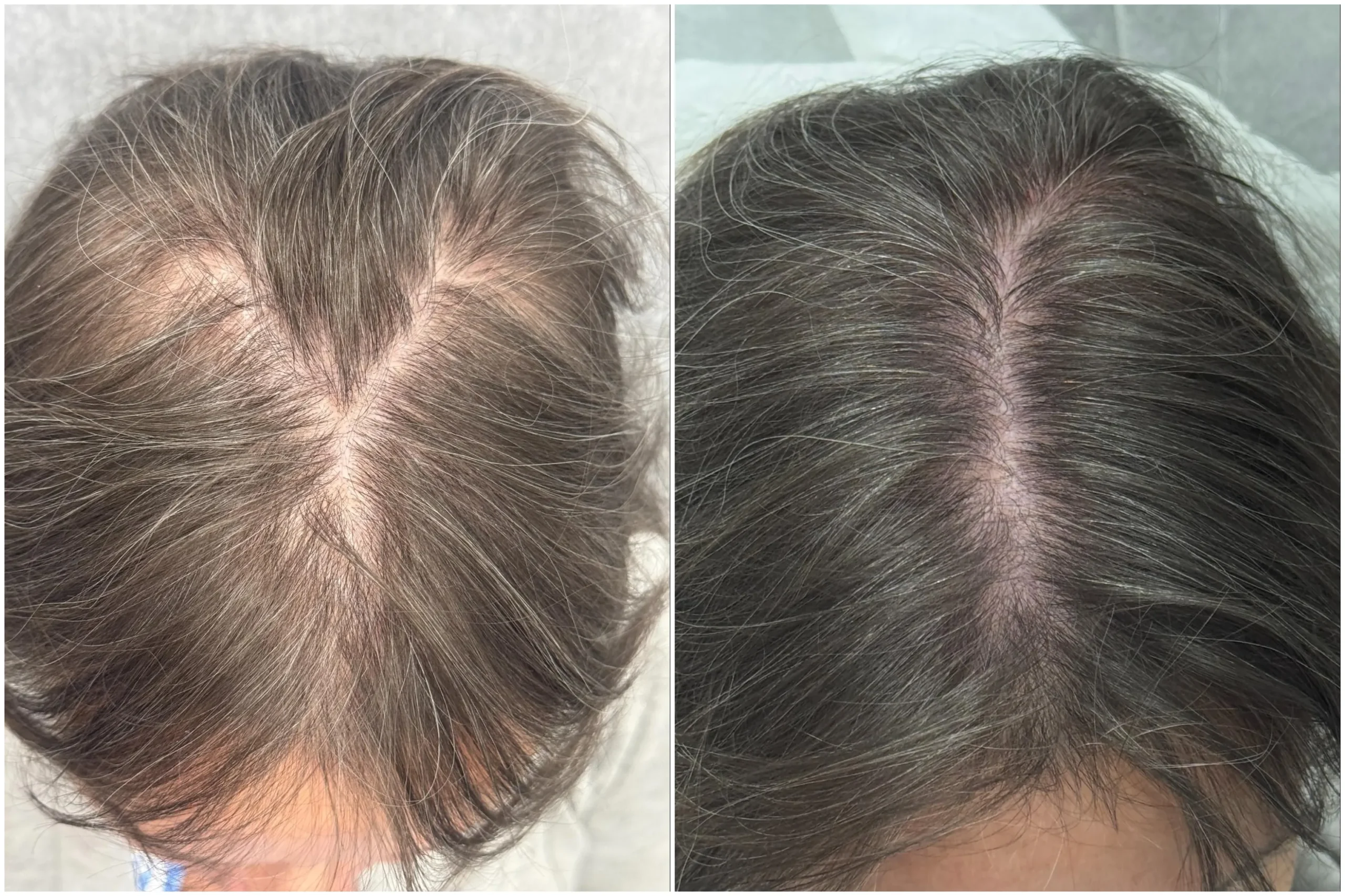
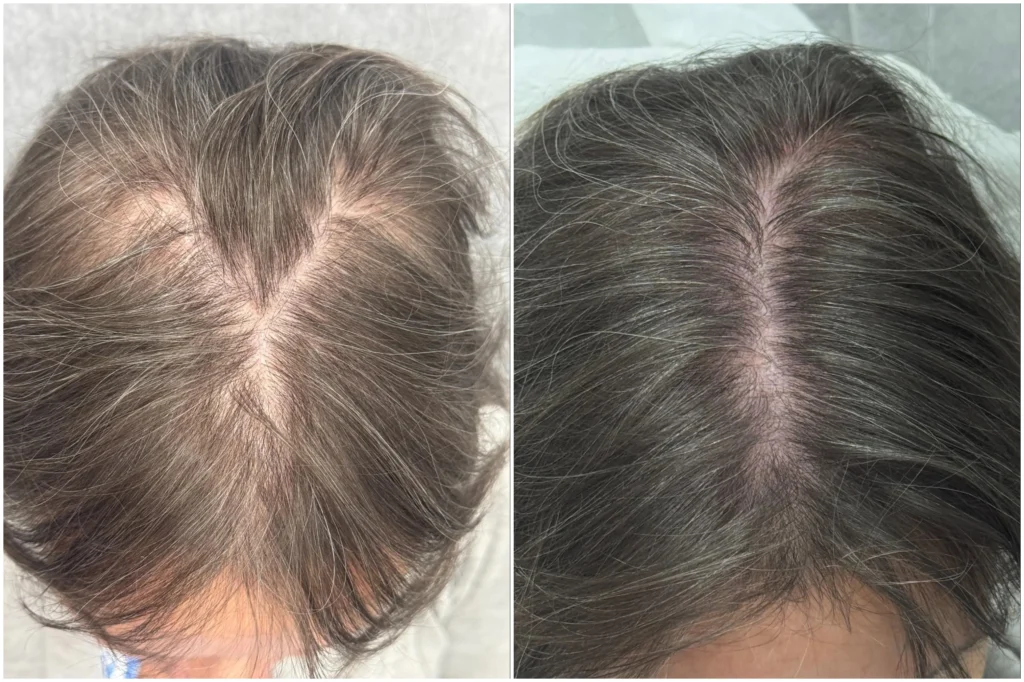
PRP has the strongest research of the regenerative hair treatments. A meta-analysis of clinical trials found that PRP significantly improved hair density, thickness and follicle count, with only minor, temporary side effects.4 A separate review of 21 randomized trials in women with hair loss found that PRP increased both hair density and thickness.5 PRP also adds to minoxidil: a meta-analysis found better hair density with PRP plus minoxidil than with minoxidil alone, although the included trials were small,6 and in a randomized trial, PRP plus topical minoxidil produced the largest gain in terminal hair density over 32 weeks.7
PRP works best for early to moderate thinning while follicles are still alive. It is not a cure, and results fade without maintenance.1 The most common side effect is temporary scalp tenderness during and after the injections. Because PRP depends on healthy platelets, let us know if you take aspirin, blood thinners or other antiplatelet medications.
Typical plan at REJUVA: monthly treatments for 3 to 5 sessions, then maintenance once every 4 to 6 months.
PRFM (Injectable PRF): A Newer, Slower-Release Option
Platelet-rich fibrin matrix (PRFM), also called injectable platelet-rich fibrin (PRF), is also made from your own blood. It is prepared without an anticoagulant, so it forms a soft fibrin gel that releases growth factors more slowly and for longer than PRP. In theory, that sustained release could be an advantage.8
Early results are encouraging. In a small comparison study, injectable PRF increased hair density by about 24% compared with about 18% for PRP, and the gains held at 6 months.8 However, PRFM has not yet been tested in randomized controlled trials for hair loss, so it is considered promising rather than proven. At REJUVA, PRFM follows the same schedule as PRP: monthly for 3 to 5 sessions, then maintenance every 4 to 6 months.
Low-Level Laser Therapy (LLLT) and Laser Caps
Low-level laser therapy, also called red light therapy or photobiomodulation, uses gentle red light to boost energy production in hair follicle cells. This helps follicles re-enter the growth phase. It does not heat or damage the skin. Several caps, helmets and combs are FDA-cleared for hair loss.1
The evidence is strong. A 2025 review of 38 studies and 3,098 patients found that LLLT significantly increased hair density compared with placebo devices in people with pattern hair loss, with larger benefits after more than 20 weeks of use.9 An earlier meta-analysis of 11 randomized trials found consistent gains in men and women with both comb- and helmet-style devices.10 In a 16-week randomized, double-blind trial of a helmet device, users gained about 42 hairs per square centimeter compared with almost no change in the placebo group, with no side effects.11
Whether LLLT adds benefit for people already using minoxidil is less clear. A 2025 meta-analysis of 4 randomized trials found no significant difference in hair count or thickness when LLLT was added to minoxidil.12 LLLT may be most useful for people who prefer a drug-free option or cannot use minoxidil.
LLLT is very safe; occasional scalp tenderness or tingling is the most common complaint.1 The key is consistency. REJUVA offers both in-office LLLT and laser caps for home use, so you can choose what fits your schedule. Home caps are typically worn several times a week, and results take several months to appear.
Scalp Microcirculation Massage Therapy
Scalp microcirculation massage therapy uses targeted massage to increase blood flow to the scalp and gently stretch the tissue around hair follicles. In a small study of men with thinning hair, 4 minutes of standardized daily scalp massage for 24 weeks increased hair thickness.13 The evidence is limited, so we use it as a relaxing, low-risk add-on to PRP, PRFM, laser therapy and medication rather than as a stand-alone treatment. [Add 1 sentence on how the REJUVA treatment is delivered, e.g., device name, session length.]
Exosomes for Hair Loss: What You Should Know
Exosomes are tiny particles released by cells, usually stem cells grown in a laboratory, that carry growth signals. They are heavily marketed for hair and skin rejuvenation. Early clinical studies, most of them small and without control groups, have reported increases in hair density and thickness with mild, temporary side effects.14
It is important to understand what is and is not known. The research is still early, and products vary widely in what they contain and how they are made.14 No exosome product is FDA-approved.15
At REJUVA, we offer hair exosome treatments as part of a combination plan, after a full evaluation and a clear discussion of the benefits, limits and regulatory status. Treatments follow the same schedule as PRP: monthly for 3 to 5 sessions, then maintenance every 4 to 6 months. If you are considering exosomes anywhere, ask what the product is, where it comes from and how it is handled.
Comparison Table: Nonsurgical Hair Loss Treatments at a Glance
| Treatment | How it works | Strength of evidence | Side effects | FDA status |
|---|---|---|---|---|
| Minoxidil and finasteride | Prolong growth phase; block hormone that shrinks follicles | Strong | Scalp irritation; unwanted hair growth; sexual side effects with finasteride | Approved (topical minoxidil, oral finasteride) |
| PRP | Concentrated growth factors from your own blood | Strongest of the regenerative options; multiple meta-analyses | Temporary scalp tenderness | Uses your own blood; no product approval required |
| PRFM | Fibrin gel with slower growth-factor release | Early; small studies, no randomized trials | Temporary scalp tenderness | Uses your own blood |
| Low-level laser (LLLT) | Red light energizes follicle cells | Strong; randomized trials and meta-analyses | Minimal | Several devices FDA-cleared |
| Scalp microcirculation massage | Boosts scalp blood flow; gently stretches tissue around follicles | Limited; small studies | None expected | Not a drug or device approval issue |
| Exosomes | Lab-derived particles carrying growth signals | Preliminary; small, mostly uncontrolled studies | Mild in reported studies; product quality varies | Not FDA-approved |
Individual results vary. Your plan is based on an in-person evaluation.
Why We Combine Treatments at REJUVA
Each treatment works in a different way, so combining them often beats using any one alone. Studies show better results when PRP is added to minoxidil,6,7 and when PRP is paired with microneedling and LLLT.16 At REJUVA, a typical layered plan looks like this:
- A thorough evaluation of your scalp, hair pattern, medical history and medications, with blood tests when needed.
- A medical foundation, such as topical or oral minoxidil, chosen to fit your health history.
- PRP, PRFM or exosome treatments monthly for 3 to 5 sessions, then maintenance every 4 to 6 months.
- Low-level laser therapy in the office or with a laser cap at home.
- Scalp microcirculation massage therapy to support scalp blood flow.
- FUE hair transplant when areas have lost too many follicles for nonsurgical treatment to restore. Dr. Mazloom performs FUE hair restoration at REJUVA.
Are You a Good Candidate?
You are likely a good candidate for nonsurgical hair restoration if you have noticeable thinning but still have hair in the affected areas, your hair loss has been gradual, and you are willing to commit to a few months of treatment and periodic maintenance. Both men and women benefit, and age alone is not a barrier. Many of our patients in their 60s and 70s see meaningful improvement.
Nonsurgical treatment is less likely to help areas that have been smooth and bald for years, because those follicles are no longer active. In that case, an FUE hair transplant usually gives a better result, and PRP and LLLT can still help protect the surrounding hair. PRP may not be right for you if you have a platelet or bleeding disorder, take certain blood-thinning medications, or have an active scalp infection. We will tell you honestly which approach fits you best.
What to Expect: Results, Timeline and Maintenance
- Consultation: we evaluate the pattern and cause of your hair loss, review your medications, take standardized photos and build a plan with you.
- Treatment day: a PRP visit takes about an hour, including the blood draw and preparation. We use numbing and cooling to keep you comfortable.
- Downtime: little to none. You may have scalp tenderness or mild swelling for a day or two after PRP.
- When you see results: hair grows slowly. Most people notice less shedding first, then visible thickening at about 3 to 6 months, with the best results at 6 to 12 months.
- How long results last: pattern hair loss continues over time, so maintenance PRP sessions, daily medication and regular LLLT use help keep your results.
An honest note on the evidence: PRP and LLLT are well studied, but studies use different preparation methods, devices and schedules, and many follow patients for months rather than years.1,4 We base our recommendations on the best available research and our own clinical experience.
Frequently Asked Questions
What Is the Best Nonsurgical Treatment for Thinning Hair?
For most people with pattern hair loss, the best results come from combining treatments: a medication such as minoxidil plus PRP injections, with an FDA-cleared low-level laser device as a drug-free option. PRP and LLLT have the strongest evidence among the newer treatments.
Does PRP Really Work for Hair Loss?
Yes, for many people. Meta-analyses of clinical trials show that PRP increases hair density and thickness in men and women, and adding it to minoxidil may improve results further. It works best for early to moderate thinning and requires maintenance sessions.
Is PRFM Better Than PRP for Hair?
PRFM (injectable PRF) releases growth factors more slowly, and one small study found slightly greater density gains than PRP. However, it has not been tested in randomized trials for hair loss yet, so PRP remains the better-proven choice. Many patients do well with either as part of a combination plan.
Are Exosomes FDA-Approved for Hair Loss?
No exosome product is FDA-approved. Early studies show increases in hair density and thickness, but they are small. REJUVA offers hair exosome treatments as part of a combination plan after discussing the benefits, limits and regulatory status with you.
Do Laser Caps for Hair Loss Work?
Yes. Several laser caps and helmets are FDA-cleared, and research covering more than 3,000 patients shows they increase hair density compared with placebo devices. They must be used consistently for several months to see results.
Is It Too Late to Treat Thinning Hair After 60?
No. Many people in their 60s and 70s respond well to PRP, LLLT and medication, as long as follicles are still present. Because hair loss in older adults often has more than one cause, an evaluation comes first.
How Many PRP, PRFM or Exosome Sessions Will I Need?
At REJUVA, we recommend monthly treatments for 3 to 5 sessions, then maintenance once every 4 to 6 months. Your plan depends on how much thinning you have and how you respond.
How Much Does PRP for Hair Loss Cost?
Cost depends on the treatments and number of sessions you need. These treatments are cosmetic and not covered by insurance. We review costs with you at your consultation.
Where Can I Get PRP and Hair Loss Treatment Near Venice or Sarasota, FL?
REJUVA Dermatology in Venice, FL offers PRP, PRFM, hair exosomes, in-office LLLT, laser caps, scalp microcirculation massage therapy, oral and topical medications, and FUE hair transplant under the direction of double board-certified dermatologists, serving patients from Sarasota, Nokomis, Osprey, North Port, Englewood and the Wellen Park area.
Schedule a Hair Restoration Consultation in Venice, FL
If your hair is thinner than it used to be, the sooner you start, the more hair you can protect. At REJUVA Dermatology, a double board-certified dermatologist will find the cause of your hair loss and design a plan that fits your goals, health and budget.
REJUVA Dermatology, Cosmetic & Weight Loss Center
395 Commercial Ct, Ste C, Venice, FL 34292 · (941) 529-0070 · Book an appointment
Serving Venice, Sarasota, Nokomis, Osprey, North Port, Englewood and Wellen Park.
About the Author
Sean E. Mazloom, MD, FAAD, Double Board-Certified Dermatologist and Mohs Surgeon, is co-founder of REJUVA Dermatology in Venice, Florida. He performs FUE hair transplantation and leads REJUVA’s hair restoration program, which combines oral and topical medications, PRP, PRFM, exosomes, laser therapy and FUE hair transplantation. He earned his medical degree at Chicago Medical School and trained at Cleveland Clinic, Case Western University Hospitals and Weill Cornell Medicine in New York City. He previously served on the clinical dermatology faculty at the Icahn School of Medicine at Mount Sinai, and in 2019 he presented a live demonstration of PRFM for androgenetic alopecia in New York. Read Dr. Mazloom’s full bio.
References
- Devjani S, Ezemma O, Kelley KJ, Stratton E, Senna M. Androgenetic alopecia: therapy update. Drugs. 2023;83(8):701-715. doi:10.1007/s40265-023-01880-x
- Haddad N, Arruda S, Swearingen A, Forouzan E, Sadick NS. Evaluating the efficacy of platelet rich plasma and 1550 nm fractional laser in combination and alone for the management of androgenetic alopecia. J Drugs Dermatol. 2022;21(11):1166-1169. doi:10.36849/JDD.6750
- Penha MA, Miot HA, Kasprzak M, Müller Ramos P. Oral minoxidil vs topical minoxidil for male androgenetic alopecia: a randomized clinical trial. JAMA Dermatol. 2024;160(6):600-605. doi:10.1001/jamadermatol.2024.0284
- Papakonstantinou M, Siotos C, Gasteratos KC, Spyropoulou G, Gentile P. Autologous platelet-rich plasma treatment for androgenic alopecia: a systematic review and meta-analysis of clinical trials. Plast Reconstr Surg. 2023;151(5):[pages]. doi:10.1097/PRS.0000000000010076
- Yuan [author list]. Effectiveness of platelet-rich plasma in treating female hair loss: a systematic review and meta-analysis of randomized controlled trials. Skin Res Technol. 2024;30(8):e70004. doi:10.1111/srt.70004
- Yao J, Zhu L, Pan M, Shen L, Tang Y, Fan L. The additive value of platelet-rich plasma to topical minoxidil in the treatment of androgenetic alopecia: a systematic review and meta-analysis. PLoS One. 2024;19(8):e0308986. doi:10.1371/journal.pone.0308986
- Janaani P, Kumar N, Kumar V, Kumaran MS, Mehta H, Vinay K. Analysing efficacy of low-dose oral minoxidil, topical minoxidil, and platelet-rich plasma with topical minoxidil combination in patients with androgenetic alopecia: a randomized controlled observer blinded trial. Arch Dermatol Res. 2025;317(1):421.
- Farshidfar N, et al. Platelet-rich plasma (PRP) versus injectable platelet-rich fibrin (i-PRF): a systematic review across all fields of medicine. Periodontol 2000. Published online March 24, 2025. doi:10.1111/prd.12626
- Perez SM, Vattigunta M, Kelly C, Eber A. Low-level laser and LED therapy in alopecia: a systematic review and meta-analysis. Dermatol Surg. 2025;[volume(issue):pages]. doi:10.1097/DSS.0000000000004442
- Liu KH, Liu D. Comparative effectiveness of low-level laser therapy for adult androgenic alopecia: a system review and meta-analysis of randomized controlled trials. Lasers Med Sci. 2019;34(6):1063-1069.
- Yoon JS, Ku WY, Lee JH, Ahn HC. Low-level light therapy using a helmet-type device for the treatment of androgenetic alopecia: a 16-week, multicenter, randomized, double-blind, sham device-controlled trial. Medicine (Baltimore). 2020;99(29):e21181. doi:10.1097/MD.0000000000021181
- Alosaimi A, Algarni A, Alharbi A, Alotaibi A, Alomairi A, Alsurayhi M, et al. Comparative efficacy of minoxidil alone versus minoxidil combined with low-level laser therapy in the treatment of androgenic alopecia: a systematic review and meta-analysis. J Dermatolog Treat. 2025;36(1):2447355. doi:10.1080/09546634.2024.2447355
- Koyama T, Kobayashi K, Hama T, Murakami K, Ogawa R. Standardized scalp massage results in increased hair thickness by inducing stretching forces to dermal papilla cells in the subcutaneous tissue. Eplasty. 2016;16:e8.
- Ahmad [author list]. [Exosome therapy for hair loss: scoping review; complete title]. Periodontol 2000. 2026.
- US Food and Drug Administration. Public safety notification on exosome products. Accessed October 1, 2026. https://www.fda.gov/vaccines-blood-biologics/safety-availability-biologics/public-safety-notification-exosome-products
- Gentile P, Dionisi L, Pizzicannella J, de Angelis B, De Fazio D, Garcovich S. A randomized blinded retrospective study: the combined use of micro-needling technique, low-level laser therapy and autologous non-activated platelet-rich plasma improves hair re-growth in patients with androgenic alopecia. Expert Opin Biol Ther. 2020;20(9):1099-1109. doi:10.1080/14712598.2020.1797676