Written and medically reviewed by Sean E. Mazloom, MD, FAAD, Double Board-Certified Dermatologist and Mohs Surgeon
REJUVA Dermatology & Vein Center | Venice, Florida
Table of Contents
The Short Answer
If you are 75, 80, 90, or older and have been diagnosed with basal cell carcinoma (BCC) or squamous cell carcinoma (SCC), age alone does not tell you whether you need Mohs surgery, excision, radiation, or observation. For most BCCs and SCCs, surgery still has the most established cure rates. But the best choice depends on the cancer’s risk, your overall health and life expectancy, how well you would tolerate treatment, and what matters most to you.
A common question we hear from older adults in Venice, Sarasota, Wellen Park, North Port, and surrounding Southwest Florida communities is: “At my age, is treating this skin cancer worth it?” The answer can be very different for a healthy 78-year-old with a high-risk cancer on the nose than for a frail 92-year-old with a small, asymptomatic, low-risk BCC.
At Age 75 or Older, What Should Determine My Skin Cancer Treatment?
- The diagnosis: BCC versus SCC and the histologic subtype
- The location: face, eyelid, nose, ear, scalp, hand, trunk, arm, or leg
- The tumor’s size, borders, recurrence history, and other high-risk features
- Your overall health, frailty, medications, mobility, and ability to heal
- Whether repeated treatment visits or wound care would be difficult
- Your priorities: maximum cure, avoiding surgery, convenience, appearance, or comfort
Chronological age is only one piece of that decision.
If I Am Healthy and Over 75, Is Mohs Still Worth Doing?
Often, yes, when Mohs is otherwise appropriate for the tumor. Mohs is typically performed under local anesthesia in an office setting and is usually completed in one treatment visit. For high-risk cancers or tumors on cosmetically and functionally important areas such as the nose, eyelids, lips, ears, scalp, and hands, Mohs can offer a combination of high cure rates and tissue preservation.
What If I Am 80 or 90?
There is no universal age cutoff. A healthy, independent person in their 80s or 90s may tolerate Mohs very well. The more useful question is whether the expected benefit of treating this particular cancer is meaningful given your health, function, and goals.
When Might EBT or Another Radiation Treatment Make More Sense?
Radiation can be considered when surgery is medically difficult, wound healing is a concern, reconstruction would be challenging, or a patient strongly prefers a nonsurgical approach after understanding the advantages and limitations.
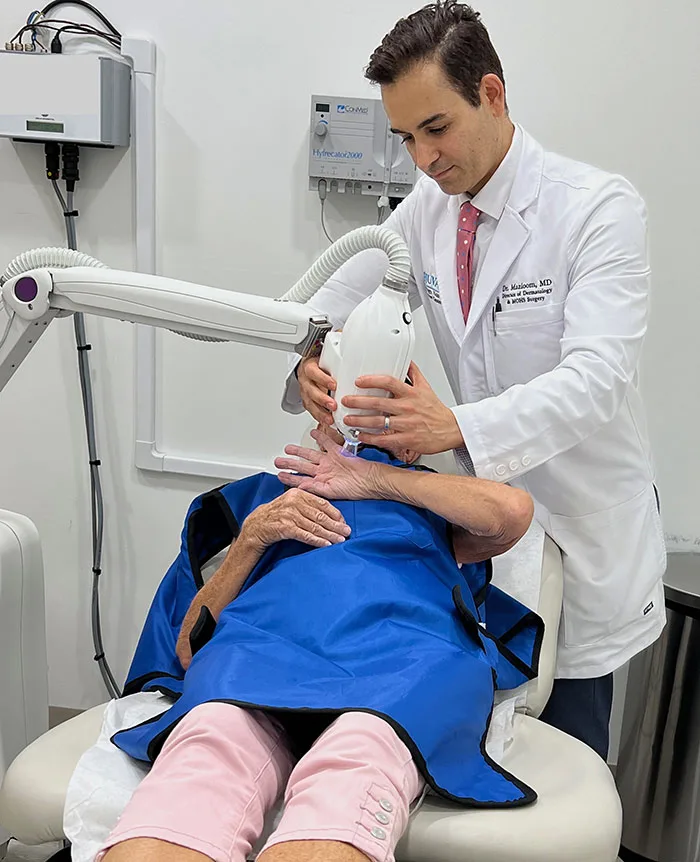
At REJUVA, we offer electronic brachytherapy (EBT) for appropriately selected BCCs and SCCs. EBT delivers focused radiation at the skin surface without an incision or stitches. Our protocol typically requires approximately 10 to 12 treatment sessions. Conventional SRT protocols may require more visits over several weeks, depending on the treatment plan.
Why Does the Number of Radiation Visits Matter More as Patients Get Older?
Transportation, mobility, caregiver availability, fatigue from repeated appointments, and the cumulative burden of treatment can become important. A shorter treatment course may be more practical, but convenience should not override whether the treatment is appropriate for the cancer.
Can I Simply Leave a Basal Cell Carcinoma Alone After Age 75?
Sometimes, but only in carefully selected circumstances. Active surveillance may be reasonable for a patient with significant frailty or limited life expectancy who has a small, asymptomatic, low-risk BCC and for whom the burden of treatment may exceed the expected benefit. This is not the same as ignoring the cancer; it requires follow-up and a plan to reconsider treatment if the lesion changes.
Watchful waiting is generally not appropriate for most SCCs, aggressive BCC subtypes, rapidly growing tumors, symptomatic lesions, or cancers threatening important structures such as the eye, nose, or ear.
What Changes Mean a Watched Skin Cancer Should Be Reevaluated?
- Meaningful growth
- Repeated bleeding
- Pain or tenderness
- Ulceration or breakdown
- Interference with daily function
- Movement toward the eye, nose, ear, or another important structure
A Practical Comparison for Adults Over 75
| Situation | Mohs / excision | EBT / radiation | Active surveillance |
| Healthy, active; meaningful life expectancy | Often favored when appropriate for tumor risk | May be reasonable if surgery is declined or unsuitable | Usually not preferred for a cancer that warrants treatment |
| Higher-risk cancer on nose/eyelid/ear/lip | Mohs often particularly valuable | Case-dependent alternative when surgery is unsuitable | Generally not appropriate |
| Medical/healing concerns or strong desire to avoid surgery | May still be possible depending on health | Often the main alternative to discuss | Only for selected low-risk situations |
| Severe frailty, limited life expectancy, small asymptomatic low-risk BCC | Treatment burden must be weighed carefully | May still be more treatment than needed in some cases | May sometimes be reasonable with follow-up |
What Should I Ask Before Deciding?
- Is my cancer low risk or high risk, and why?
- What happens if I delay or do not treat it?
- Why are you recommending Mohs, excision, EBT, SRT, or observation for me specifically?
- How many visits will I need?
- What wound care, skin reaction, or recovery should I expect?
- How do my medications and medical conditions change the recommendation?
- What are the likely cosmetic tradeoffs at this location?
Getting a Second Opinion When the Choice Is Not Obvious
If you have been told you need Mohs but are worried about surgery, or if you have been offered radiation and want to know whether surgery would be more definitive, a treatment-focused second opinion can be useful. Bring the pathology report and, if available, the biopsy-site photograph or location information. The goal is not to choose the least invasive treatment automatically; it is to understand which reasonable option best fits the cancer and your health.
Skin Cancer Consultations for Older Adults in Venice and Sarasota-Area Communities
REJUVA offers Mohs surgery and electronic brachytherapy, so appropriately selected patients can discuss both surgical and nonsurgical treatment pathways. Call (941) 529-0070 to schedule a skin cancer treatment consultation at 395 Commercial Court, Suite C, Venice, FL 34292. We frequently care for patients from Venice, Sarasota, Wellen Park, North Port, Englewood, and nearby Gulf Coast communities.
Frequently Asked Questions
Am I Too Old for Mohs Surgery at 75, 80, or 90?
Not necessarily. Age alone is generally not a reason to avoid Mohs. Overall health, function, medications, tumor characteristics, and treatment goals matter more.
Is Radiation Safer Than Mohs for an Elderly Patient?
Not automatically. Mohs is usually performed with local anesthesia and can be well tolerated by older adults. Radiation avoids an incision but requires multiple treatments and can cause short- and long-term skin changes. Safety depends on the individual patient and tumor.
Is EBT a Good Option If I Do Not Want Surgery?
It may be for appropriately selected BCCs or SCCs after the surgical option and the limitations of radiation are discussed. At REJUVA, EBT generally involves about 10 to 12 sessions.
Can a 90-Year-Old Choose No Treatment for Basal Cell Carcinoma?
In selected frail patients with limited life expectancy and a small, asymptomatic, low-risk BCC, active surveillance may sometimes be reasonable. It should be an intentional medical decision with follow-up, not simply abandonment of care.
Should I Get a Second Opinion Before Radiation or Mohs?
A second opinion can be useful when the recommendation is not clear to you, when you have significant medical concerns, or when you want to understand both surgical and nonsurgical options before committing to treatment.
Sources
1. American Academy of Dermatology. Guidelines of care for the management of basal cell carcinoma.
2. American Academy of Dermatology. Guidelines of care for the management of cutaneous squamous cell carcinoma.
3. National Comprehensive Cancer Network. NCCN Clinical Practice Guidelines in Oncology: Basal Cell Skin Cancer.
4. National Comprehensive Cancer Network. NCCN Clinical Practice Guidelines in Oncology: Squamous Cell Skin Cancer.
5. van Winden MEC, et al. Evaluation of Watchful Waiting and Tumor Behavior in Patients With Basal Cell Carcinoma: An Observational Cohort Study of 280 Basal Cell Carcinomas in 89 Patients. JAMA Dermatology. 2021;157(10):1174-1181.
6. Bhatnagar A. Nonmelanoma skin cancer treated with electronic brachytherapy: results at 1 year. Brachytherapy. 2013;12(2):134-140.
7. Doggett S, et al. Long-term clinical outcomes of non-melanoma skin cancer patients treated with electronic brachytherapy. Journal of Contemporary Brachytherapy. 2023.
8. Paravati AJ, et al. Comparison of electronic brachytherapy and Mohs micrographic surgery for the treatment of early-stage non-melanoma skin cancer: a matched pair cohort study. Journal of Contemporary Brachytherapy. 2017.
This article is for general educational purposes and is not a substitute for an individualized medical evaluation.