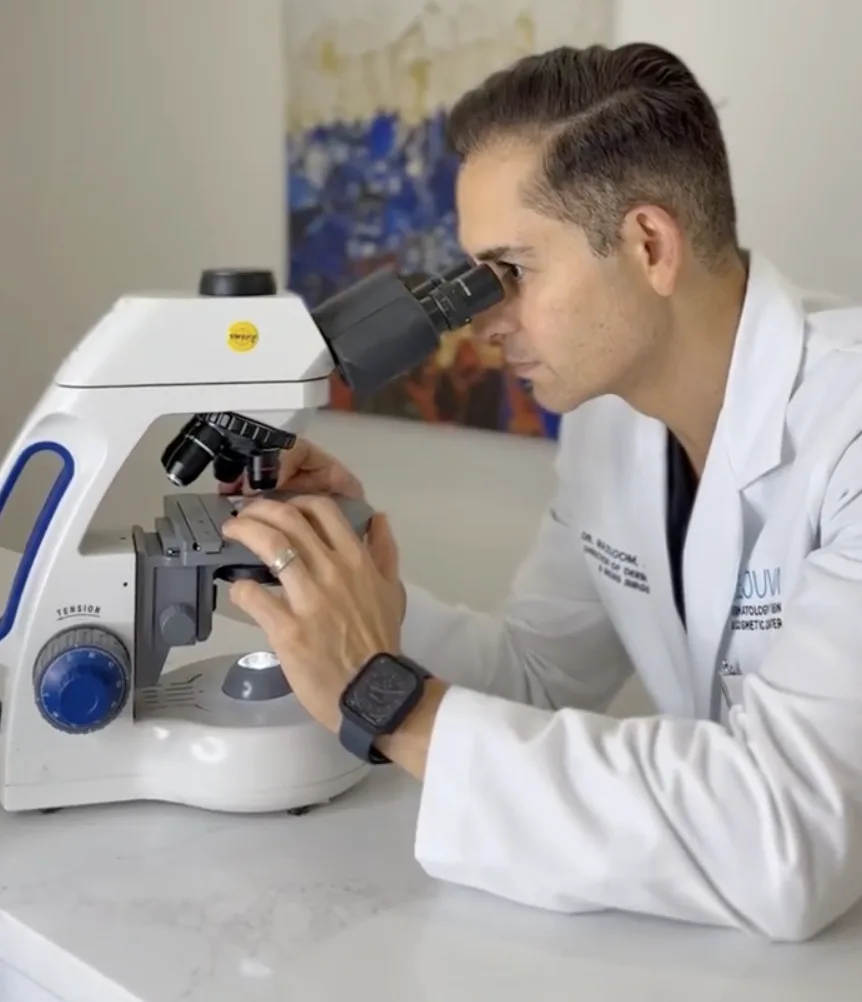
Written and medically reviewed by Sean E. Mazloom, MD, FAAD — Double Board-Certified Dermatologist and Mohs Surgeon
REJUVA Dermatology, Vein & Cosmetic Center | Venice, Florida
Table of Contents
The short answer: Is Mohs surgery safe for seniors?
Yes—Mohs surgery can be performed safely in appropriately selected adults in their 80s and 90s, and age alone is generally not a reason to rule it out. Mohs is usually performed in the office with local anesthesia rather than general anesthesia, and large studies have reported low complication rates, including in very old patients.
The better question is not “Am I too old for Mohs?” but “Given my health, medications, mobility, and this particular skin cancer, are the benefits of Mohs worth the procedure and recovery for me?”
Why might a dermatologist recommend Mohs to someone in their 80s or 90s?
Mohs is often recommended for higher-risk basal cell carcinomas and squamous cell carcinomas, recurrent tumors, poorly defined cancers, and cancers on areas where preserving normal tissue matters—such as the nose, eyelids, lips, ears, scalp, and hands. The surgeon removes the cancer in thin layers and examines the mapped margins during the same visit, continuing only where cancer remains.
Does Mohs surgery require general anesthesia?
Usually not. The treatment area is numbed with local anesthetic while the patient remains awake. Avoiding general anesthesia is one reason Mohs can be practical for many older adults. Most patients go home the same day.
What are the actual complication rates in older Mohs patients?
Several studies are reassuring, while also showing why individual health factors still matter:
- A prospective multicenter study of 20,821 Mohs procedures reported adverse events in 0.72% of cases and serious events in 0.02%, with no deaths or permanent disabilities reported.
- A study comparing patients younger and older than 80 found complication rates of 7% in both groups, despite older patients tending to have larger and deeper tumors.
- Among 1,683 Mohs procedures in patients age 85 and older, the complication rate was 1.78%. Factors associated with complications included blood-thinner use, arm or leg tumors, more than two Mohs stages, and flap reconstruction—not age alone.
These numbers should not be used to predict an individual patient’s risk. The size and location of the cancer, repair required, medications, circulation, smoking status, and overall health can all matter.
Not sure whether Mohs makes sense at your age? Schedule a skin cancer consultation at REJUVA in Venice: (941) 529-0070.
What is recovery like after Mohs for an older adult?
Recovery depends more on the wound and reconstruction than on the birthday. Some swelling, bruising, redness, and tenderness are common during the first several days. Pain is often mild and decreases quickly; acetaminophen is frequently sufficient.
Wound care commonly continues for roughly 7–14 days. Stitches, when used, are often removed about 5–14 days after surgery depending on the location and repair. Larger flaps, grafts, lower-leg wounds, and patients with healing limitations may require more follow-up.
How long will I be at the office on Mohs day?
Plan for several hours. The actual surgical stages may be brief, but tissue must be processed and examined under the microscope between stages. The number of stages cannot be known with certainty before surgery.
Should I stop blood thinners before Mohs surgery?
Do not stop a prescribed anticoagulant or antiplatelet medication on your own. Evidence generally supports continuing medically necessary blood-thinning therapy for many Mohs procedures because bleeding is often manageable, while stopping therapy can expose some patients to serious clotting or cardiovascular risk. Medication decisions should be individualized with the prescribing clinician when necessary.
What if I have a pacemaker, heart disease, diabetes, or mobility problems?
These conditions do not automatically rule out Mohs, but they can affect planning. Tell your Mohs surgeon about cardiac devices, anticoagulants, diabetes medications, oxygen use, mobility limitations, allergies, prior surgical complications, and whether you have help at home. For some patients, the main issue is not the local anesthetic—it is transportation, prolonged sitting, wound care, or the complexity of reconstruction.
When might Mohs not be the best choice for a senior?
Mohs is not automatically the right treatment simply because a patient has skin cancer. A very frail patient with limited life expectancy and a small, slow-growing, low-risk tumor may have different priorities. Depending on the diagnosis and location, alternatives can include standard excision, curettage, topical therapy, radiation, or in carefully selected low-risk BCCs, active surveillance.
What nonsurgical option does REJUVA offer?
REJUVA offers electronic brachytherapy (EBT) for appropriately selected BCCs and SCCs. EBT is a skin-directed radiation treatment with no incision or stitches. Our protocol generally involves approximately 10–12 treatment sessions. It may be considered when surgery is undesirable or medically difficult, but it is not a universal replacement for Mohs.
How do I know whether Mohs is worth it at my age?
Ask your dermatologist or Mohs surgeon to explain the decision in terms of your specific cancer rather than your age alone:
- How aggressive is this tumor if I do nothing?
- Why is Mohs being recommended instead of standard excision?
- How large a wound or reconstruction is likely?
- What are my personal bleeding or healing risks?
- Would EBT or another nonsurgical option be medically reasonable?
- How many visits and how much home wound care will each option require?
- What outcome are we trying to prevent—recurrence, growth into an important structure, pain, bleeding, or functional/cosmetic damage?
Mohs surgery for seniors in Venice, Sarasota, and Southwest Florida
At REJUVA Dermatology, Vein & Cosmetic Center, Mohs surgery is performed in the office under local anesthesia. Because we also offer EBT for appropriately selected skin cancers, older adults and their families can discuss both surgical and nonsurgical approaches when more than one option is medically reasonable.
If you or a family member has been referred for Mohs and wants to understand safety, recovery, or alternatives, call 941-529-0070 to schedule a consultation at 395 Commercial Ct, Suite C, Venice, FL 34292. We serve patients from Venice, Sarasota, Wellen Park, North Port, Englewood, and surrounding Southwest Florida communities.
Frequently asked questions
Is 80 too old for Mohs surgery?
No. Age alone is not a contraindication. Research comparing patients above and below age 80 found similar complication rates in that study.
Can a 90-year-old have Mohs surgery?
Yes. Mohs can be appropriate for patients in their 90s when the expected benefit is meaningful and their overall health and circumstances make the procedure reasonable. Studies in patients 85 and older have reported low complication rates.
Is Mohs painful?
The area is numbed with local anesthetic. Patients may feel pressure or movement during the procedure. Postoperative pain is often mild and typically decreases substantially after the first day.
Can I stay on Eliquis, Xarelto, warfarin, aspirin, or Plavix for Mohs?
Do not stop a prescribed blood thinner without medical guidance. Many medically necessary anticoagulant and antiplatelet medications are continued for Mohs, but the decision should be individualized.
Is radiation easier than Mohs for an elderly person?
It depends. Radiation avoids an incision but requires repeated treatment visits and can cause skin reactions. Mohs is usually one treatment visit but requires a surgical wound and aftercare. The tumor and the patient’s health determine which tradeoff is more appropriate.
Can I get a second opinion if I am nervous about Mohs?
Yes. A second opinion can clarify why Mohs was recommended, what reconstruction may involve, and whether another treatment such as EBT is medically reasonable for your exact cancer. Patients from Sarasota, Wellen Park, North Port, and Englewood can schedule a second opinion or a skin cancer screening at our Venice office.
References
1. Wehner MR. Keratinocyte Carcinoma: A Review. JAMA. 2026;335(1):70-81. doi:10.1001/jama.2025.18749
2. Maciejewska M, et al. Mohs Micrographic Surgery: A Narrative Review of Current Practices, Emerging Trends, and Case-Based Insights. Adv Ther. 2025;42(11):5397-5426. doi:10.1007/s12325-025-03354-w
3. Etzkorn JR, Alam M. What Is Mohs Surgery? JAMA Dermatol. 2020;156(6):716. doi:10.1001/jamadermatol.2020.0039
4. Thomson J, et al. Interventions for Basal Cell Carcinoma of the Skin. Cochrane Database Syst Rev. 2020;11:CD003412. doi:10.1002/14651858.CD003412.pub3
5. Work Group, Kim JYS, et al. Guidelines of Care for the Management of Basal Cell Carcinoma. J Am Acad Dermatol. 2018;78(3):540-559. doi:10.1016/j.jaad.2017.10.006
6. Alam M, et al. Adverse Events Associated With Mohs Micrographic Surgery: Multicenter Prospective Cohort Study of 20,821 Cases at 23 Centers. JAMA Dermatol. 2013;149(12):1378-1385. doi:10.1001/jamadermatol.2013.6255
7. Camarero-Mulas C, et al. Mohs Micrographic Surgery in the Elderly: Patients Younger and Older Than 80 Years Old in REGESMOHS. J Eur Acad Dermatol Venereol. 2018;32(1):108-112. doi:10.1111/jdv.14586
8. Nemer KM, Ko JJ, Hurst EA. Complications After Mohs Micrographic Surgery in Patients Aged 85 and Older. Dermatol Surg. 2021;47(2):189-193. doi:10.1097/DSS.0000000000002452
9. Pham VX, et al. Evaluating Postoperative Outcomes of Mohs Surgery in the Elderly: A Retrospective Review of Large Repairs. J Drugs Dermatol. 2025;24(5):537-538. doi:10.36849/JDD.8489
10. Cook JL, Perone JB. A Prospective Evaluation of the Incidence of Complications Associated With Mohs Micrographic Surgery. Arch Dermatol. 2003;139(2):143-152. doi:10.1001/archderm.139.2.143
11. Maisel-Campbell A, et al. Nonmelanoma Skin Cancer in Patients Older Than Age 85 Years Presenting for Mohs Surgery. JAMA Dermatol. 2022;158(7):770-778. doi:10.1001/jamadermatol.2022.1733
12. Ruiz-Salas V, et al. Complications Associated With Mohs Micrographic Surgery: Data From the Nationwide Prospective Cohort REGESMOHS. Dermatology. 2022;238(2):320-328. doi:10.1159/000517010
13. National Comprehensive Cancer Network. Older Adult Oncology. September 4, 2026.
14. Ong J, Feig JL, Grant-Kels JM. Beyond Appropriate Use Criteria: Ethical Considerations When Forgoing Mohs Micrographic Surgery. Clin Dermatol. 2026. doi:10.1016/j.clindermatol.2026.07.027
This article is for educational purposes and is not a substitute for individualized medical advice. Please discuss your specific situation with your physician.